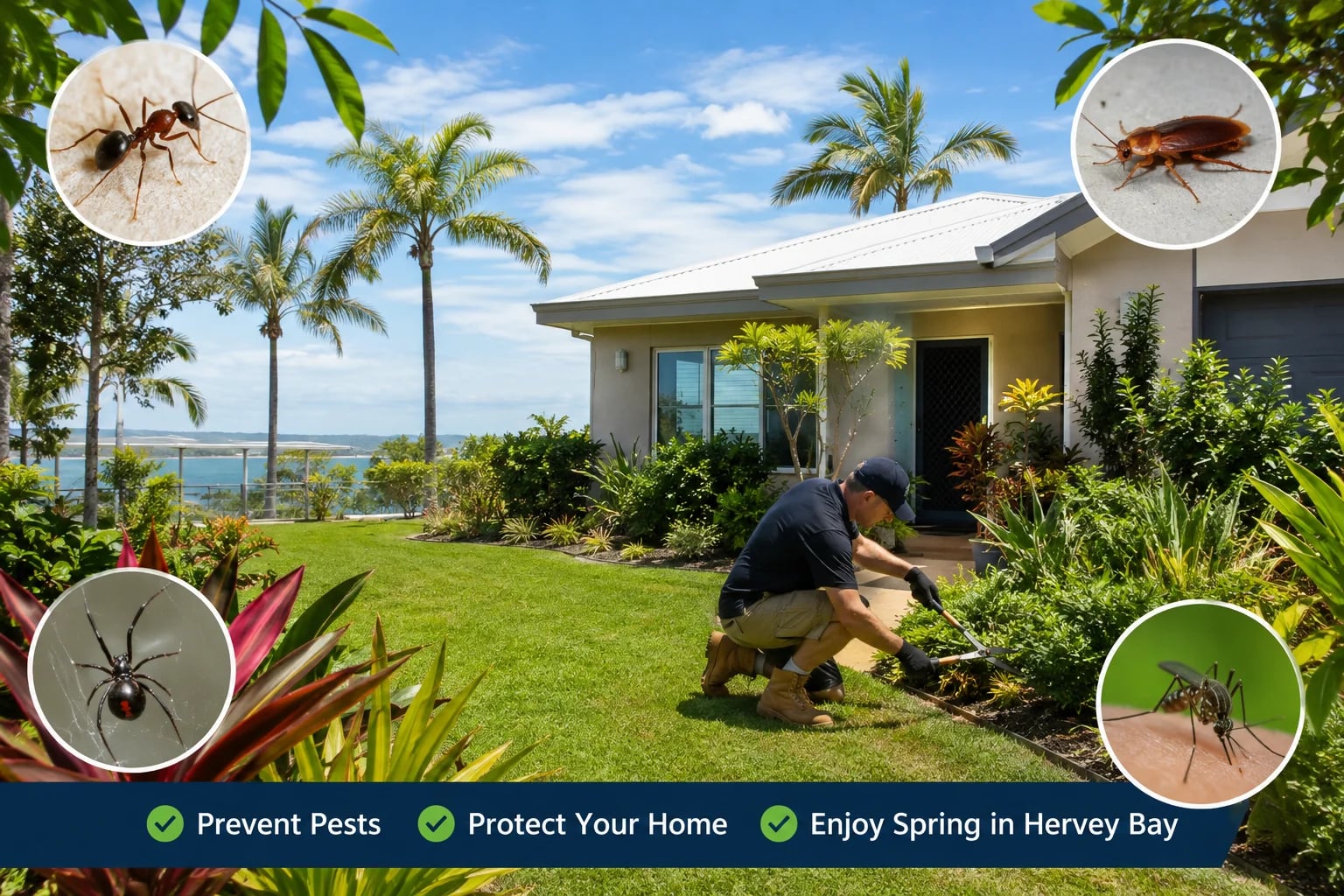
Spring Pest Prevention Guide for Hervey Bay & the Fraser Coast
Spring in Hervey Bay means warmer days, gardens coming back to life, more time outdoors and the beginning of another beautiful Queensland warm season.
Unfortunately, we’re not the only ones who enjoy the warmer weather.
As temperatures rise across the Fraser Coast, insects and other pests become increasingly active. Cockroaches begin moving around in greater numbers, ant colonies become more noticeable, spiders follow their food supply, mosquitoes take advantage of standing water, and flies and other insects can quickly become a nuisance around the home.
The good news?
You don’t have to wait until you’ve got an infestation before doing something about it.
In fact, spring is one of the best times of the year to inspect your property, remove pest harbourage areas and put preventative measures in place.
As a local pest control technician servicing Hervey Bay and the Fraser Coast, I regularly see homes where relatively simple preventative work could have dramatically reduced the pest pressure around the property.
So before spring gets properly underway, here’s my practical NoTrace guide to preparing your home.
DIY first. Professional pest control when you need it.
Why Does Spring Bring More Pests Around Hervey Bay?
Pest activity is closely connected to environmental conditions.
Hervey Bay’s coastal Queensland climate provides pests with three things they need:
Warmth, moisture and food.
As winter gives way to spring, increasing temperatures can accelerate insect activity and reproduction. Add rainfall, irrigation, lush gardens, humidity and plentiful food sources, and conditions can quickly become favourable for many common household pests.
This doesn’t necessarily mean your house is dirty.
Even a beautifully maintained home can experience pest problems.
The difference is often what is happening around the house.
A leaking garden tap, overflowing pot-plant saucer, overgrown garden touching the building, overflowing rubbish bin or small opening around plumbing can be enough to give pests the opportunity they need.
That’s why good pest management starts outside.
The NoTrace Spring Pest Prevention Checklist
Before reaching for a can of insect spray, walk around your property and look at it from a pest’s point of view.
Ask yourself:
Where can pests find water?
Where can they find food?
Where can they hide?
How can they get inside?
Remove those opportunities and you’ve already taken a major step towards preventing an infestation.
Here’s where I’d start.
1. Clean Up Around the Outside of Your Home
One of the most effective pest prevention jobs you can do costs virtually nothing.
Clean up the yard.
Pests love undisturbed areas.
Look around sheds, fences, patios, garden beds and the perimeter of your house for:
- piles of timber
- cardboard boxes
- unused pots
- old garden equipment
- leaf litter
- palm fronds
- accumulated garden waste
- unused building materials
- rubbish
- dense vegetation
- items stored directly against external walls.
These areas provide shade, moisture and protection from predators.
Cockroaches, spiders, ants, rodents and many other pests can use clutter as harbourage.
Move stored items away from the house wherever practical and keep frequently overlooked areas accessible enough to inspect and clean.
2. Trim Gardens Away From the House
This is one of my favourite simple pest-prevention recommendations.
Don’t let the garden become a bridge into your house.
Trim shrubs, palms, trees and other vegetation so they aren’t constantly touching external walls, windows, rooflines and gutters.
Overgrown vegetation creates sheltered areas where insects can live and allows ants and other crawling pests easier access to the structure.
It can also make pest inspections considerably more difficult.
Pay particular attention to:
- shrubs against external walls
- branches touching the roof
- palms beside gutters
- dense plants around air-conditioning units
- vegetation around windows
- garden beds covering weep holes
- vines growing against the building.
You don’t need to turn your garden into a desert.
The objective is simply to create some separation between vegetation and the house.
Think of it as creating a pest buffer zone around your home.
3. Remove Standing Water Before Mosquito Season Ramps Up
This one is particularly important around coastal Queensland.
Mosquitoes need water to breed, and surprisingly small amounts of standing water can become potential breeding habitat.
Walk around your property after rain and look for anything collecting water.
Check:
- buckets
- children’s toys
- wheelbarrows
- tarps
- blocked gutters
- pot-plant saucers
- bird baths
- discarded containers
- boats
- trailers
- drains
- old tyres
- pet bowls
- water tanks and associated screens.
Empty unnecessary containers and store them upside down where possible.
Clean gutters and drainage areas so water can flow freely.
Queensland Health specifically recommends removing containers holding water around homes and yards and ensuring mosquito-proof screens on water tanks are intact.
Warm and wet conditions can substantially increase mosquito numbers.
Don’t Forget Your Flyscreens
Inspect flyscreens on:
- windows
- sliding doors
- bathroom windows
- laundry doors
- outdoor entertaining areas.
Repair holes and make sure screens fit correctly.
A tiny repair now can save you from spending spring evenings chasing mosquitoes around the bedroom.
When choosing personal mosquito repellents, look for products containing recognised active ingredients such as DEET or picaridin and always follow the product label.
4. Cockroach-Proof Your Kitchen Before the Warmer Weather
Cockroaches are one of Queensland’s classic household pests.
And prevention starts with food and water.
Cockroaches don’t need a beautifully laid-out dinner.
Crumbs underneath an appliance, grease around the stove, pet food left overnight or moisture underneath the sink can provide what they need.
Give your kitchen a proper spring clean.
Pull out accessible appliances where safe and clean:
- underneath the fridge
- beside the dishwasher
- underneath the microwave
- around the oven
- inside lower cupboards
- underneath the sink
- around the rubbish bin
- behind small appliances.
Pay particular attention to grease and food residue.
Store Food Properly
Transfer vulnerable dry foods into sealed containers.
This includes:
- flour
- cereal
- rice
- pasta
- pet food
- biscuits
- baking ingredients.
This also helps protect food from pantry pests.
Don’t Leave Pet Food Out Overnight
Your dog might be finished with dinner.
The cockroaches might not be.
Where practical, remove leftover pet food and clean bowls and feeding areas.
If you’re repeatedly catching cockroaches, especially small cockroaches in kitchens or appliances, there may be a breeding population requiring a more targeted treatment.
5. Stop Ants Before They Establish Highways Through the House
Few things announce warmer Queensland weather quite like a trail of ants suddenly appearing across a kitchen bench.
The biggest DIY mistake I see with ants is concentrating only on the ants you can see.
You wipe them away.
They return.
You spray them.
They return somewhere else.
That’s because the visible ants may only represent a small part of the colony.
Instead, concentrate first on removing the resources attracting them.
Clean food residue from benches and floors, store sugary foods properly, seal pet food and check for leaking taps or other moisture sources.
Outside, inspect around:
- garden edges
- pavers
- paths
- pot plants
- retaining walls
- rubbish areas
- outdoor kitchens
- patios
- around windows and doors.
If you’re using an ant bait, use a product suitable for the situation and follow the label exactly.
Avoid randomly spraying insecticide over an active baiting area, because you may interfere with ants taking the bait.
How To Stop Ants Invading Your Queensland Home – The Ultimate NoTrace Guide
6. Make Your Home Less Attractive to Spiders
When customers ask how to stop spiders, I usually explain something important:
Think about the spider’s food as well as the spider.
Spiders go where prey is available.
If your home attracts lots of flying and crawling insects, you’re effectively providing spiders with a food supply.
Outdoor lighting can contribute to this by attracting insects around doors, patios and windows.
Also remove spider webs where practical and regularly inspect:
- eaves
- pergolas
- outdoor furniture
- sheds
- garages
- pool equipment
- letterboxes
- children’s outdoor equipment
- underneath BBQ covers.
Always use caution around unidentified spiders.
Don’t put your hands into dark spaces where you can’t see what is inside.
Shake Before You Wear
If shoes, gloves, gardening equipment or clothing have been sitting unused in a garage or shed, inspect or shake them out before use.
7. Seal the Gaps Pests Use to Enter
You’d be surprised how many pest problems start with a small building gap.
During your spring inspection, look around:
- doors
- windows
- plumbing penetrations
- air-conditioning pipework
- utility penetrations
- garages
- sheds
- roofline gaps
- damaged screens.
Install or replace door seals where daylight is visible underneath external doors.
Seal appropriate gaps around pipes and services.
However, don’t blindly seal every opening in a building.
Weep holes and other designed ventilation or drainage openings serve a purpose and should not simply be filled with silicone or foam.
If you’re unsure why an opening exists, find out before sealing it.
8. Check Your Bins and Outdoor Eating Areas
Spring means BBQs, outdoor meals and entertaining.
It can also mean flies, ants and cockroaches.
Make sure rubbish-bin lids close properly.
Clean food residue from the inside and outside of bins and don’t allow bags of rubbish to accumulate beside them.
After BBQs, clean:
- grease trays
- cooking surfaces
- food scraps
- outdoor tables
- pet feeding areas
- drink spills.
A forgotten BBQ grease tray can become an excellent food source for pests.
If possible, position bins away from frequently used doors and windows.
9. Don’t Forget the Garage and Garden Shed
Garages and sheds often become pest hotels because they’re quiet and rarely disturbed.
Spring is the perfect time to reorganise them.
Replace cardboard storage boxes with durable plastic containers where practical.
Keep floors clear enough to inspect.
Look for:
- cockroach droppings
- spider webs
- gnaw marks
- damaged food or pet-food packaging
- rodent droppings
- nesting material
- unusual smells.
If you’re storing bird seed, grass seed or pet food in the garage, keep it in secure containers.
10. Look for Early Signs of Rats and Mice
Rodents aren’t exclusively a winter problem.
Food, water and shelter around a property can support rats and mice at different times of year.
During your spring clean, watch for:
- droppings
- gnaw marks
- scratching noises
- greasy rub marks
- damaged food packaging
- shredded nesting material
- activity around bins
- noises in the roof.
Also trim vegetation and branches where appropriate and keep stored materials organised.
Be Careful With DIY Rodent Baits
Rodent control requires more thought than simply throwing bait into the roof.
Poorly positioned rodenticides can create risks for children, pets and non-target animals.
If you use a domestic rodent-control product, read and follow the label carefully and use appropriate tamper-resistant stations where required.
If you’ve got ongoing roof activity or aren’t sure whether you’re dealing with a rat, mouse or another animal, professional identification is the better option.
Should I Spray My Own House for Pests?
You can absolutely perform a lot of pest prevention yourself.
In fact, I encourage it.
Good sanitation, garden maintenance, removing standing water, reducing clutter, repairing screens, sealing appropriate entry points and storing food properly can dramatically reduce pest pressure.
Where DIY becomes less effective is when an infestation has already become established.
Buying several different aerosol cans and spraying every insect you see isn’t necessarily an integrated pest-management strategy.
Sometimes it simply kills the pests you can see while doing very little about the underlying population.
If you do use domestic pesticides, always read and follow the label.
Never assume that using more chemical will produce a better result.
Keep products away from children and pets, use them only in locations permitted by the label and follow all safety directions.
Pest-management activities undertaken professionally using pesticides and fumigants are regulated in Queensland, and pest management technicians carrying out regulated activities must hold the appropriate licence.
When Should You Call a Professional Pest Controller?
DIY prevention should always be your first line of defence.
But there comes a point where professional pest control makes sense.
Consider getting professional help when:
- cockroaches continually return after DIY treatment
- you’re seeing numerous small cockroaches around kitchens
- ant trails repeatedly return
- you’re regularly finding spiders around living areas
- rodents are active in the roof or walls
- you find repeated droppings
- pests are affecting food-storage areas
- you’ve got a significant flea problem
- you’re unsure what pest you’re dealing with
- you’ve tried DIY methods without solving the problem
- pest activity is becoming widespread around the property.
A professional treatment should be more than someone walking around spraying insecticide.
Good pest management involves identification, inspection, treatment and prevention advice.
At NoTrace Pest Control, we look at what’s happening around the property and help identify the conditions that may be contributing to the problem.
Your Hervey Bay Spring Pest Prevention Shopping List
If you’re preparing the house this weekend, here’s a useful DIY kit:
- Flyscreen repair kit [AMAZON AFFILIATE LINK]
- Door seals/weather stripping [AMAZON AFFILIATE LINK]
- Airtight pantry containers [AMAZON AFFILIATE LINK]
- Heavy-duty storage tubs [AMAZON AFFILIATE LINK]
- Long-handled cobweb brush [AMAZON AFFILIATE LINK]
- Suitable exterior gap sealant [AMAZON AFFILIATE LINK]
Always check the product label and make sure the product is suitable for its intended use.
The 30-Minute NoTrace Spring Pest Check
Don’t have time for a massive spring clean?
Do this.
Walk around your property with your phone and spend 30 minutes looking for these ten things:
1. Standing water – empty it.
2. Vegetation touching the house – trim it where appropriate.
3. Leaf litter and garden debris – remove it.
4. Damaged flyscreens – repair them.
5. Gaps underneath doors – install suitable seals.
6. Food residue and grease – clean it.
7. Open pet-food bags – seal them.
8. Clutter around sheds and garages – organise it.
9. Spider webs and insect activity – note where you’re seeing it.
10. Droppings or gnaw marks – investigate them.
Take photos of anything you’re unsure about.
Those 30 minutes can tell you a surprising amount about the pest pressure around your property.
Prevention Beats Infestation
The biggest mistake homeowners make with pest control is waiting until pests become impossible to ignore.
By that stage, you may already have an established population.
Spring gives Hervey Bay homeowners a great opportunity to get ahead of the warmer months.
Reduce food.
Reduce moisture.
Reduce harbourage.
Block appropriate entry points.
Monitor pest activity.
And deal with problems while they’re still small.
You don’t need to turn your home into a chemical fortress.
Good pest control starts with making your property a difficult place for pests to live.
That’s the principle behind effective integrated pest management and it’s something almost every homeowner can start doing themselves.
Need Pest Control in Hervey Bay or the Fraser Coast?
If you’ve completed your spring pest check and you’re still finding cockroaches, ants, spiders, rodents or other unwanted visitors, it might be time for professional help.
NoTrace Pest Control provides professional pest control services throughout Hervey Bay and the Fraser Coast, including solutions for common household pests such as cockroaches, ants, spiders, fleas, rodents and other crawling and flying insects.
We’re local, licensed and familiar with the pest pressures that come with living in coastal Queensland.
Our approach is simple:
Identify the problem. Treat what’s necessary. Help you prevent it from coming back.
Get an Instant quote and book your spot.
Frequently Asked Questions
When should I organise pest control for spring in Hervey Bay?
Late winter and early spring are excellent times to inspect your property and put preventative measures in place before warmer conditions increase insect activity. If you’re already seeing significant pest activity, however, there’s usually little benefit in waiting.
Why do I suddenly get more insects when the weather warms up?
Many insects are strongly influenced by temperature, moisture and food availability. Warmer Queensland conditions can increase insect activity and reproduction, which is why pest activity can become much more noticeable heading into spring and summer.
What is the best way to prevent cockroaches?
Start by reducing access to food, water and harbourage. Clean food residue and grease, don’t leave pet food sitting overnight, repair plumbing leaks, reduce clutter and monitor kitchens and bathrooms for activity. Persistent cockroach problems may require professional treatment.
How can I reduce mosquitoes around my Hervey Bay home?
Regularly inspect your yard for standing water. Empty containers, clean gutters, check pot-plant saucers, inspect rainwater tanks and screens and maintain flyscreens around the house. Personal insect repellents containing ingredients such as DEET or picaridin can also help reduce bites when used according to the label.
How do I stop ants coming inside?
Clean up food and sugary residue, store food securely, fix moisture problems, and monitor where ant trails enter. Appropriate ant baits can work well for some situations because worker ants can carry bait back towards the colony. Persistent infestations may require professional identification and treatment.
Does keeping my house clean prevent all pests?
No. Cleanliness certainly helps, but pests can enter even very clean homes. Environmental conditions, gardens, moisture, building gaps, neighbouring properties and seasonal changes can all influence pest activity.
Is professional pest control better than DIY pest control?
They serve different purposes. DIY prevention and basic monitoring are extremely valuable and should be part of every homeowner’s routine. Professional pest control becomes particularly useful when an infestation is established, the pest can’t be confidently identified, DIY treatments repeatedly fail, or specialised treatment is required.
About NoTrace Pest Control
NoTrace Pest Control provides professional pest management for homes and businesses across Hervey Bay and the Fraser Coast, Queensland.
We believe effective pest control isn’t just about killing the pest you can see.
It’s about understanding why it’s there in the first place.
For more practical pest advice, browse the NoTrace Pest Control Blog and Pest Library.
Need pest control help?
I'm here to help with all your pest control needs on the Hervey Bay & Fraser Coast. Get in touch for a free quote.